
Among the Old Growth: Washington Trails, Native Trees, and Healing Plants
I have loved trees for as long as I can remember.
Climbing them. Bark under my palms. Sap on my fingers. That one branch that gave a better view than the ground ever could. Nests tucked into corners, checked like I had a role to play. A few falls along the way. Nothing serious. Luck, or maybe good timing.
There was a village festival every year in my childhood rural community. Loud, alive, bustling, stretched over a week. On the last day, I went with my parents.
By evening, I was spent.
I slipped away.
At the edge of the grounds stood a banyan tree. I went straight to it and settled down between the roots. Next thing I remember, I’m waking up to a circle of faces. My parents, a few others, relief written clearly across all of them. They had been searching for an hour. The whole place in motion.
That still feels like the most natural place to end up.
Even now, I step into a forest and something in me clicks into place. The air changes. Resin, damp earth, a faint sweetness if a plant gets brushed along the way. Breath deepens without effort.
Trees have always held my attention in a very direct way. They take light from a distant star and turn it into food. Every breath, every step, every living thing traces back to that first quiet act.
Walk a trail in Washington and you see it everywhere. Douglas fir pushing straight up. Cedar holding space in its own way. Smaller plants working close to the ground, easy to miss unless you slow your pace.
This is not a guide to using or collecting. It is a slower kind of noticing. Learning to recognize what grows along the trail. So we walk. We look closer. We let the forest do what it does best. Quietly, steadily, it teaches.
“A tree is a slow explosion of life.” - Bruno Munari
Douglas Fir
You start to recognize it after a while. The height, for one. Straight, assured. Then the scent. A hint of citrus woven into something deeper, wood and rain and time. Douglas fir, Pseudotsuga menziesii, is everywhere in these forests, though “everywhere” feels like an understatement. It shapes the skyline, holds the soil, carries light down through its branches. Indigenous communities steeped needles into tea for colds, tended their cuts or sore with resin.

Stand near one long enough and your breathing changes on its own. The air feels cleaner, sharper. There is research behind that, antimicrobial compounds, volatile oils. The forest has its own way of keeping things in balance. You notice it in your body before you think about it.
There is also something less measurable. A steadiness. These trees take storms directly and remain. Weathered in places, shaped by time. Still present.
How to notice it
Soft, flat needles that don’t prick when you run your fingers lightly along a fallen twig. Cones scattered on the ground, each scale edged with a small three-pointed bract. Some say it looks like a tiny tail. Once you see it, you can’t unsee it.
A small way to meet it
Pause. Stand close enough to catch the scent. Let it settle in your lungs for a few breaths. Then keep walking.
“All things are connected. Whatever befalls the earth befalls the children of the earth." - Chief Seattle
Western Red Cedar
You usually sense it before you study it. The air deepens. The light softens. There is a quiet shift underfoot, as if the forest has stepped into an older rhythm. Western red cedar, Thuja plicata, holds a long relationship with the peoples of this region. Often called the Tree of Life, it has offered shelter, tools, clothing, and medicine across generations. Canoes shaped from its trunk. Bark woven into baskets and mats. Oils and leaves used in care and ceremony.

Stand near cedar and the scent settles in slowly. Earthy, steady, almost anchoring. The chemistry is real, aromatic compounds that contribute to its preservative and cleansing qualities. Your body reads it in a simpler way. Breath eases. Thoughts space out a little.
Cedar carries a certain presence. Broad at the base, reaching upward, often surrounded by a quiet circle of space. There is a sense of shelter in it, a kind of holding.
How to notice it
Leaves arranged in flat, fan-like sprays, soft to the touch. Bark that peels in long, fibrous strips, reddish brown and textured. Mature trees often feel expansive, with a form that suggests both age and patience.
A small way to meet it
Pause beside the trunk. Let your hand rest lightly on the bark. Take in the scent, unhurried. Then continue on, carrying that steadiness with you.
“If we could see the miracle of a single flower clearly, our whole life would change.” - Gautama Buddha
Wild Chamomile
You’ll likely miss it at first. Then one step lands just right and the air lifts, a soft, sweet note, something close to pineapple, warm and familiar. Wild chamomile, Matricaria discoidea, keeps close to the ground. Trailsides, open patches, places where the soil has been disturbed. Easy to overlook. Easy to walk past. Those who have known it longest have brewed it into tea for the stomach, for rest, for easing the edges of a long day.

How to notice it
Low-growing, with small dome-shaped flowers, green-yellow, without petals. Leaves fine and feathery, almost lace-like. Often found where feet have passed before.
A small way to meet it
Let your fingers pass lightly over the plant as you walk and breathe deeply.
Salal
Salal moves differently. Dense, steady, filling the understory with a quiet kind of abundance. Glossy leaves catching the light. Berries forming slowly, deepening into dark purples as the season turns. For many Indigenous communities, salal has been a reliable source of nourishment. Berries gathered, dried, shaped into food that carried through winter. Leaves used in simple ways to support the body.

Walk through a patch and the leaves brush against your legs. There is a scent there, subtle, earthy, grounding.
How to notice it
Oval leaves, thick and smooth, with a waxy sheen. Berries small, clustered, shifting from green to deep purple. Often forming wide, low thickets along the trail.
A small way to meet it
If berries are in season, pause and observe.
Yarrow
Yarrow feels older than it looks. Light on the surface. Strong in quiet ways. Achillea millefolium grows in open spaces, where sun reaches the ground. Feathery leaves, almost fern-like. Clusters of small flowers gathered at the top, white or soft pink. It has long been used in tending to wounds, in easing fevers, in simple forms of care passed from one generation to the next.
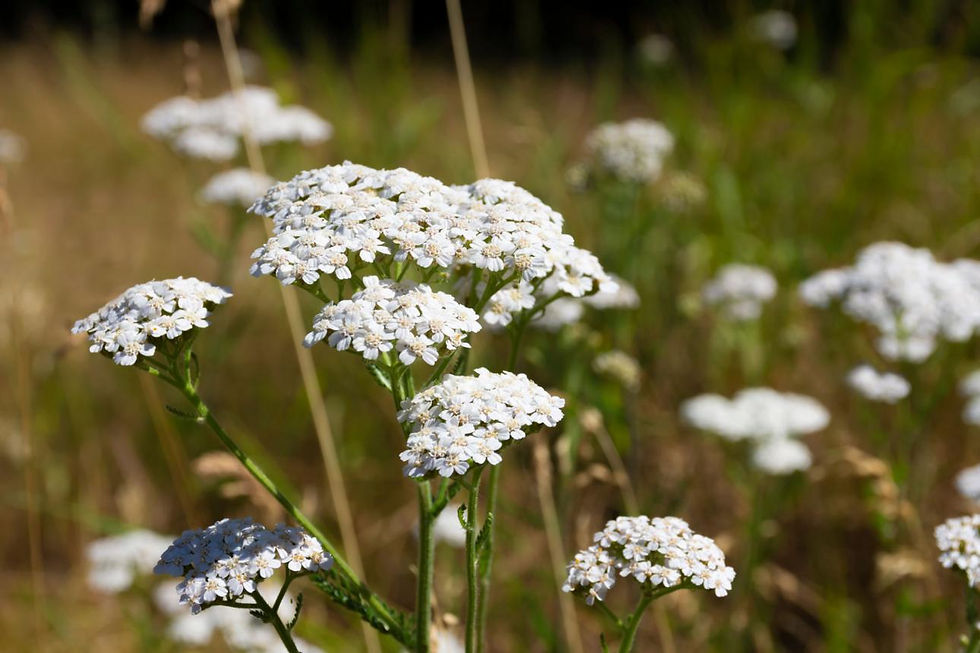
There is a steadiness in how it grows. Even in rough soil, it holds its shape. Crush a leaf gently and the scent comes through, herbal, clean, grounding. Subtle. Clear.
How to notice it
Fine, feathered leaves along the stem. Flat-topped clusters of tiny flowers. Often in open, sunny stretches where the trail widens.
A small way to meet it
Pause beside it. Let your fingers rest lightly on a leaf. Notice the texture. Then move on.
Book Recommendations
Finding the Mother Tree by Suzanne Simard
A forest ecologist from British Columbia, she spent decades studying how trees communicate through underground fungal networks. Her work shows forests as connected systems, where older trees support younger ones, sharing nutrients and information. It adds a layer to every walk. What looks like a collection of individual trees starts to feel like a conversation.
Braiding Sweetgrass by Robin Wall Kimmerer
She brings science and Indigenous knowledge into the same space. As both a scientist and a member of the Citizen Potawatomi Nation, she writes with both lenses open. The book moves between ecology and Indigenous knowledge with care and clarity. It shifts how you think about reciprocity. What it means to take, what it means to give back, and how attention itself becomes part of that exchange.
The Hidden Life of Trees by Peter Wohlleben
He makes similar ideas accessible in a very direct way. He writes about how trees respond, adapt, and support each other over time. Some of his interpretations spark debate, though the central idea remains compelling. Forests function as connected systems.
The Forest Unseen by David George Haskell
Haskell slows things down even further. Haskell, a biologist, spent a year observing a single square meter of forest. One small patch. That’s it. The level of detail he uncovers changes how you approach any landscape. You realize how much is happening in places you would usually walk right past.
The Overstory by Richard Powers
It moves into fiction, though it often feels closer to truth than expected. It weaves together multiple human stories, all orbiting around trees and forests. The scale shifts constantly, from individual lives to something much larger. It stays with you long after you finish it.
Trails Where the Forest Really Shows Up
Washington was built, in part, on timber. Through the late 1800s and much of the 1900s, logging drove towns, rail lines, and entire local economies. Old-growth forests, trees that had stood for centuries, were the primary target. Today, only a small fraction of that original old growth remains. Estimates vary, though a commonly cited range is roughly 10–20% of Washington’s original old-growth forest still standing, with the largest intact stretches now protected inside national parks and designated wilderness. The trails below pass through some of those remaining pockets. You feel the difference right away.
Hall of Mosses Trail
Location: Hoh Rainforest, Olympic National Park
About 0.8 miles, flat. This is dense, temperate rainforest at its best. Sitka spruce and western hemlock draped in moss, thick canopy, filtered light. You’re not covering distance here, you’re just taking it in. Late spring through early fall is the easiest time, though it’s open year-round. Expect moisture.

Sol Duc Falls Trail
Location: Sol Duc Valley, Olympic National Park
1.6 miles round trip, ~200 ft gain. Easy walk through old growth with a strong finish at the falls. The forest holds your attention most of the way. Summer is the most accessible; spring brings more water volume.
Carbon River Rainforest Trail
Location: Northwest section of Mount Rainier National Park
Around 5 miles round trip to the ranger station, nearly flat. Follows an old road, which makes it a relaxed walk. Big leaf maples, moss, river nearby. Less crowded than other parts of Rainier. Best from late spring through fall.
Baker Lake Trail
Location: Mount Baker-Snoqualmie National Forest
Up to 14 miles round trip, ~500 ft gain. Long, steady trail with old-growth sections mixed with lake views. Good for covering miles without much strain. Late spring through fall works best.
Ancient Groves Trail
Location: Okanogan-Wenatchee National Forest
Short, about 0.5 miles, minimal elevation. Older trees, quieter setting, more open forest compared to the coast. Easy stop if you’re exploring this side of the Cascades.
Lake 22 Trail
Location: Mountain Loop Highway, Mount Baker-Snoqualmie National Forest
5.4 miles round trip, ~1,350 ft gain. Starts in classic old-growth forest, roots, moss, sections of boardwalk, then climbs to a lake set under steep, often snow-lined cliffs. This area saw heavy logging pressure in the past, though this specific basin remained protected, which is why the forest still feels intact. Late spring through fall is ideal. It gets busy, so early starts help.

I keep coming back to these forests for a reason. Something in them holds steady, even as everything else shifts. A trail is just a way in. The rest is already there.
Walk it, take it in, leave it as you found it.
Happy trails!


Comments